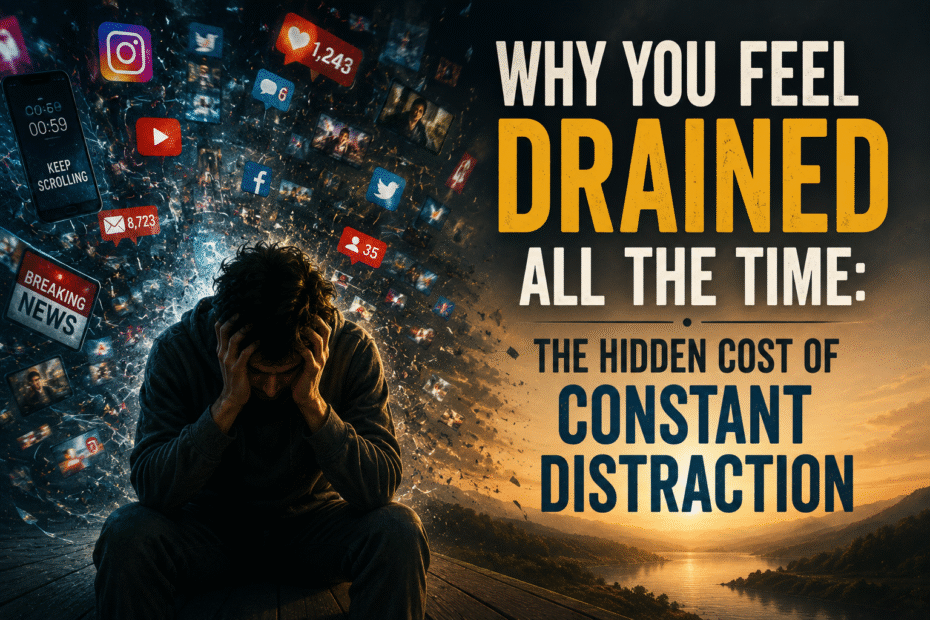
You wake up. Before your eyes fully adjust to the morning light, your hand reaches for your phone. Messages. Notifications. News alerts. Reels. Emails. In those first few moments, your mind is already flooded with information, demands, and distractions from the outside world. And somehow, even without doing anything physically exhausting, you feel tired. Not the kind of sleepy tired that a good night’s rest can fix. But a deeper, mental and emotional drain that lingers throughout the day, making simple tasks feel heavy and joy feel distant.
If this feels familiar, you are not alone. Millions of people wake up to this same cycle every single day. The real question is – why is this happening? And more importantly, what can we do about it? This isn’t just about being “busy.” It’s about a subtle, pervasive exhaustion rooted in how we interact with the modern world of endless stimulation.
You Are Never Truly “Off” Anymore
There was a time, not so long ago, when the mind had natural space to breathe. Moments of boredom during a commute, quiet evenings without screens, or simply waiting in line without filling every second with content. These pauses allowed our thoughts to settle and our nervous systems to reset.
Now, every empty second is instantly filled: scrolling through social media, watching short videos, listening to podcasts, or switching between apps. Your brain is constantly processing something – new information, opinions, images, sounds. At first, it feels harmless, even enjoyable. It keeps us connected, entertained, and informed.
But over time, something subtle and insidious begins to happen: Your mind forgets how to rest. The default state shifts from calm awareness to perpetual alertness. We have trained ourselves to be “on” 24/7, responding to every ping and dopamine hit. This constant engagement doesn’t leave room for true downtime, even when we think we’re relaxing. The result is a low-grade fatigue that builds quietly in the background, draining our reserves before we even notice.
Stimulation Feels Like Energy – But It Isn’t
Every notification delivers a small hit of excitement – a quick surge that feels productive or connective. Every new video grabs your attention with bright colors and fast cuts. Every scroll promises something better just around the corner. It mimics energy and engagement.
In reality, this is consumption without recovery. Your brain is working overtime: switching contexts rapidly between different topics, processing fragmented bits of information, and chasing novelty without any sense of completion or closure. It’s like eating sugary snacks all day instead of a nourishing meal – you get quick energy spikes followed by crashes.
This creates a hidden fatigue that is not physical but emotional and cognitive. You might not be running a marathon, yet by midday you feel wiped out. The mental bandwidth used for constant context-switching and information absorption leaves little room for sustained attention or emotional processing. What feels like staying “in the loop” is actually depleting your inner resources at an alarming rate.
The Cost You Don’t Notice Immediately
Constant stimulation doesn’t scream its harm in the moment. It creeps in gradually, showing up in ways that can feel confusing or unrelated at first. Here are some of the most common, yet overlooked, effects:
1. Reduced Focus
You find it increasingly harder to sit with one task for an extended period. Your attention jumps quickly from email to message to a quick check of the news. Deep work – those periods of concentrated effort that lead to real accomplishment – feels uncomfortable or even impossible. The mind, accustomed to rapid switches, resists the slower rhythm of focused attention. This leads to more unfinished projects and a nagging sense of underachievement.
2. Emotional Numbness
When every piece of content is designed to be intense, dramatic, or emotionally charged, nothing truly feels meaningful anymore. You consume so much that your emotional system becomes overloaded and begins to shut down as a protective mechanism. Joy from real-life moments dulls. Empathy feels harder to access. Even significant personal events can feel muted because the nervous system is already maxed out on artificial stimulation.
3. Restlessness Without Reason
You feel an urge to do something, but you don’t know what. Even when you finally have free time, true relaxation eludes you. Silence feels uncomfortable, almost threatening. The mind craves the next hit, leading to aimless scrolling or multitasking even during supposed rest periods. This restlessness keeps you in a state of low-level anxiety, preventing genuine recharge.
4. Loss of Inner Clarity
Your thoughts are no longer predominantly your own. They are heavily influenced by what you watched, read, or what others are saying online. The constant external input drowns out your inner voice – the quiet wisdom that comes from personal reflection. Slowly, you lose touch with your own values, intuition, and sense of direction. Decisions feel harder because the signal from within is buried under layers of noise.
These costs accumulate, turning what seems like a normal modern lifestyle into a source of chronic exhaustion.
You Are Feeding the Mind, But Starving the Self
This is the central paradox of our time. You are constantly giving your brain input – facts, opinions, entertainment, comparisons – but you are not giving yourself the space to process, reflect, or truly feel. Without that essential space:
- Experiences don’t have time to transform into meaningful insights.
- Information fails to become wisdom.
- Activity never fully blossoms into a sense of purpose or fulfillment.
You stay busy on the surface, checking boxes and staying “productive,” but inside, you feel strangely empty. It’s like watering the leaves of a plant while forgetting to nourish the roots. The mind gets fed, but the deeper self – the part that needs integration, creativity, and emotional digestion – starves. Over time, this imbalance manifests as that persistent drained feeling, no matter how much sleep you get or how many tasks you complete.
The Nervous System Was Not Designed for This
Your brain is an extraordinary organ, capable of remarkable feats of creativity, problem-solving, and adaptation. But it has natural limits. Evolution shaped it for:
- Depth over speed
- Presence and focused attention over constant switching
- Real-world, embodied experiences over endless digital stimulation
Today, it is forced into a relentless cycle: consume → react → move on → repeat. There is no pause for integration, no time for the nervous system to return to a calm baseline. This mismatch between our biology and our environment is what truly creates exhaustion. The sympathetic nervous system (fight-or-flight mode) stays mildly activated for hours on end, never allowing the parasympathetic system (rest-and-digest) to take over and restore balance.
The result is a body and mind that feel perpetually wired yet depleted.
The Real Problem Is Not Technology
It is easy to point fingers at phones, apps, or social media platforms. They are designed to capture and hold our attention, after all. But the deeper issue lies within us: We have become uncomfortable with stillness.
We avoid silence because it brings us face-to-face with ourselves – our unprocessed thoughts, unresolved emotions, and unanswered questions. In the quiet, we might confront feelings of loneliness, uncertainty about our path, or the gap between who we are and who we want to be. So we distract ourselves, reaching for the next notification or video. Not because we genuinely need more stimulation, but because we are trying to escape something within.
Technology is a tool, but our relationship with it has become compulsive. Recognizing this internal discomfort is the first step toward reclaiming our energy.
What Happens When You Slow Down
At first, creating space feels strange and even uncomfortable. You might automatically reach for your phone or feel the itch to fill any quiet moment. The mind protests, craving its usual diet of distractions.
But if you stay with the discomfort and allow it to pass, something beautiful begins to shift. Your mind starts to settle. Thoughts become clearer and less frantic. Emotions surface more authentically, allowing you to process them rather than numb them. You reconnect with a sense of self that had been buried under layers of noise – a self that is calmer, more creative, and more present.
Slowly, you remember what it feels like to simply be. This reconnection is profoundly restorative, often bringing back a sense of vitality you didn’t even realize was missing.
Small Shifts That Change Everything
You don’t need to disconnect from the world completely or move off the grid. Real change comes from intentional, sustainable pauses woven into everyday life. Start small:
- Sit without your phone for 10 minutes each morning, simply breathing and noticing your surroundings.
- Eat one meal without any screens, fully tasting and enjoying the experience.
- Take a walk without music or podcasts, letting your mind wander naturally.
- Allow yourself to be bored for a while and observe what arises.
If you want structured support while building this habit, guided meditation practices can be incredibly effective for training your mind to rest again.
These are not trivial acts. They are powerful practices of mental recovery. Over time, they rebuild your capacity for focus, emotional depth, and inner peace. They help your nervous system remember how to rest.
Final Reflection
Maybe the reason you feel drained is not because you are doing too much externally. Maybe it is because you are never truly stopping internally. The mind keeps racing, consuming, and reacting without respite.
The solution is not another productivity hack or more discipline. It is more presence. In a world overflowing with noise, your peace will come from the moments you consciously choose silence.
By reclaiming space for stillness, you restore balance to your mind, nourish your deeper self, and rediscover the energy that constant distraction had quietly stolen. The drained feeling doesn’t have to be your normal. With gentle awareness and small, consistent choices, you can create a life that feels lighter, clearer, and more alive.
Start today. Put the phone down for a moment. Breathe. Listen. The quiet is waiting – and it has everything you’ve been missing.
-Sunil Kumar Gautam