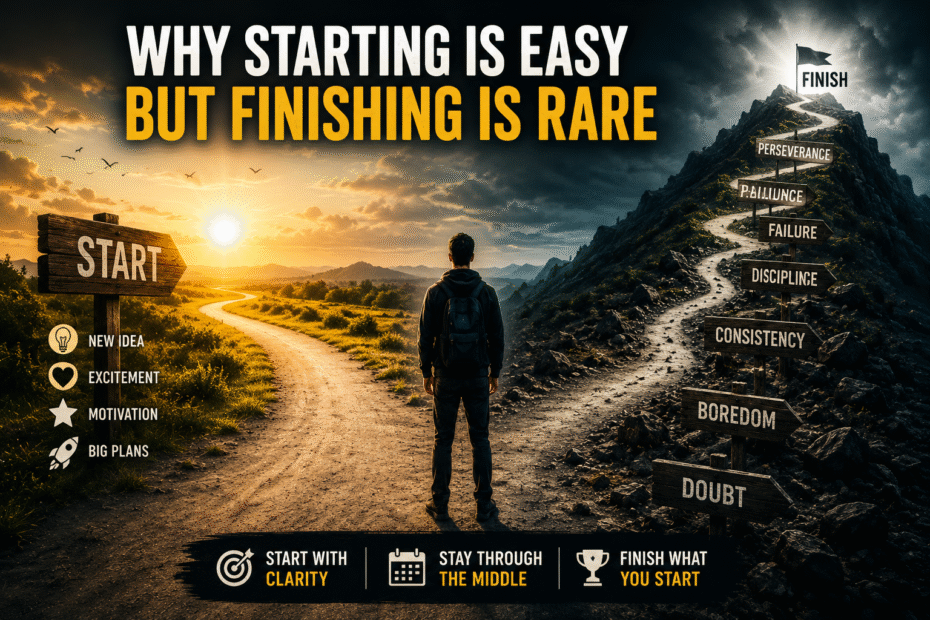
You’ve felt it. That electric burst of excitement when a new idea suddenly hits you. It could be a new project, a fresh habit you’re determined to build, or even a bold vision of a new version of yourself. In that moment, everything feels possible. You feel unstoppable, alive with potential. You start planning, visualizing the outcome, and yes – you even begin taking those first steps.
And then…
Somewhere between day 3 and day 30, something shifts. The initial energy drops. The clear vision starts to blur. The motivation that once carried you forward quietly disappears. What felt like a meaningful purpose now begins to feel like an overwhelming pressure. So you pause. You delay. You drift. And eventually, you abandon it altogether.
This cycle is incredibly common, yet deeply frustrating. It leaves behind a trail of half-finished dreams and a lingering sense of disappointment in yourself. But understanding why this happens is the first step toward breaking free from it.
The Pattern Most People Never Notice
Look closely at your life. You’ll likely see the evidence everywhere:
- Unfinished online courses you were so excited about on day one
- Half-written blogs or creative projects gathering digital dust
- Business ideas that never saw the light of launch
- Fitness routines that lasted barely two weeks
- Journals with only the first few passionate pages filled before being set aside
This is not a random coincidence or a sign of personal failure. It’s a clear, repeating pattern. And it’s not because you’re lazy, undisciplined, or incapable. Far from it.
The real reason runs deeper: starting and finishing are powered by completely different psychological systems. Once you understand this distinction, you can stop blaming yourself and start building the bridge between inspiration and completion.
Starting Is Driven by Emotion. Finishing Is Driven by Identity.
When you start something new, your brain lights up. It’s flooded with dopamine – the neurotransmitter responsible for motivation and reward. Newness equals excitement. Possibility sparks hope. Your imagination runs wild with visions of success, recognition, and transformation. At this stage, you’re not yet attached to the difficulties, setbacks, or daily grind. You’re only connected to the fantasy of how amazing it will feel when it’s done.
This is precisely why starting feels so easy and energizing. It’s emotional fuel at its purest.
But finishing? That demands something entirely different:
- Consistency even when the excitement has faded
- Taking action without immediate rewards or visible progress
- Putting in sustained effort through periods of doubt and boredom
Most importantly, finishing requires becoming someone who finishes things. It calls for an identity shift – from a dreamer who starts projects to a person defined by follow-through and completion. Without this deeper alignment, most efforts naturally fizzle out.
The Motivation Myth
Most people operate under a dangerous belief: “I’ll finish when I feel motivated.” They wait for that spark to return before continuing.
But here’s the truth: Motivation is strongest at the very beginning – and weakest exactly when it matters most.
Why? Because motivation is tied directly to emotion, and emotions are inherently unstable. They fluctuate based on your mood, energy levels, sleep quality, external stress, and even the weather. One day you wake up inspired; the next, life’s pressures make everything feel heavy.
If your entire system for progress depends on motivation, your journey will always be inconsistent and fragile. You’ll ride high during emotional peaks but crash during the inevitable valleys. Real progress requires moving beyond motivation to something more reliable: disciplined systems and a resilient identity.
The Middle Is Where Dreams Go to Die
Every meaningful journey follows three distinct psychological phases:
- The Beginning (High Energy) Full of excitement, crystal-clear vision, and surprisingly fast progress. This is the honeymoon phase where everything feels fresh and rewarding.
- The Middle (The Danger Zone) Here, boredom sets in. Confusion clouds your thinking. Results slow down or become invisible. This is the longest and most challenging phase for most people.
- The End (Rare Completion) Discipline carries you forward. Momentum begins to build again. The rewards – both internal and external – finally start to appear.
Sadly, most people never make it past Phase 2. The middle doesn’t feel good. There’s no external applause, no instant validation, and no dramatic successes to celebrate. Only quiet repetition and steady effort.
The human brain is simply not wired to embrace repetition without immediate reward. In our ancestral past, this helped us survive by seeking new opportunities. Today, it sabotages our long-term goals.
The Hidden Enemy: Cognitive Overload
When you first start a project, your brain operates in a simplified, optimistic mode. Everything feels manageable. But as you dive deeper:
- Complexity increases dramatically
- Decisions multiply at every turn
- Mistakes and obstacles inevitably appear
This buildup creates cognitive overload – a mental state where the task feels overwhelmingly expensive in terms of brainpower. Your mind starts resisting, not because the goal is impossible, but because continuing requires sustained mental effort.
So what does the brain do to seek relief? It gravitates toward quick escapes:
- Scrolling through social media
- Watching videos
- Consuming more content
- Switching to a shiny new idea
This is exactly why constant digital stimulation is so destructive to completion. It provides endless easy alternatives when the real work gets hard.
The Illusion of Progress
Here’s another subtle trap: feeling productive without actually finishing anything. Many of us fall into this loop through activities like:
- Planning and researching instead of executing
- Learning new information instead of applying it
- Organizing tools and resources without creating
This creates a dangerous illusion. Your brain gets dopamine hits from feeling productive – checking boxes, gathering knowledge, making lists – but the hard work of actual creation and completion is avoided.
Consumption quietly replaces genuine creation. You end up with knowledge and plans, but no tangible results. Breaking this cycle means prioritizing output over input.
Perfectionism: The Silent Killer
Many bright, capable people never finish because they’re waiting for things to be perfect:
- “I’ll publish the blog when it’s better written”
- “I’ll launch the business when everything is fully ready”
- “I’ll continue the habit when I’m in the right mindset”
Perfectionism feels responsible, but it’s often rooted in fear – specifically, the fear of judgment or failure. By keeping projects incomplete, you avoid the vulnerability of putting your work into the world.
The problem is that perfection is an ever-moving target. There will always be one more improvement, one more detail. True progress requires embracing “good enough” and shipping anyway.
Identity Conflict: The Deepest Reason
This may be the most powerful insight of all: You don’t finish things because your current identity doesn’t support completion.
If deep down you believe statements like:
- “I’m someone who always quits”
- “I struggle with consistency”
- “I never follow through on big goals”
Then no amount of productivity hacks or motivational quotes will overcome it. Your actions will unconsciously align with this self-image.
Changing outcomes requires changing identity first. You must begin to see yourself as someone who completes what they start.
Why Modern Life Makes It Worse
Today, finishing has become harder than ever before. Our environment actively works against sustained effort:
- Notifications constantly interrupt deep focus
- Endless content overload shrinks our attention spans
- Instant gratification culture rewires our patience for slow, compounding results
We live in a world engineered for starting many things and finishing none. Recognizing this external pressure helps us consciously design countermeasures.
So How Do You Actually Finish?
The good news? You don’t need superhuman motivation or endless willpower. You need smart systems combined with a deliberate identity shift. Here’s how:
- Reduce the Scope (Make It Finishable) Instead of overwhelming goals like “I’ll write a book,” start with “I’ll write 300 words every single day.” Completion becomes realistic when tasks feel manageable and bite-sized.
- Design Friction-Free Systems Remove decision-making from the equation. Set a fixed time, place, and action. For example: Every day at 9 PM, open your laptop and write one paragraph. No negotiation. No waiting for inspiration.
- Accept the Boring Phase Understand that boredom is not a sign of failure – it is the price of progress. If you can remain consistent when the work feels mundane, you’ll achieve what most people never do.
- Detach from Immediate Results Real growth is slow, often invisible, and compounds over time. Focus on showing up consistently rather than chasing quick success. Trust the process.
- Build a Finisher Identity Start speaking to yourself with new language: “I complete what I start.” “I am consistent, even when it’s hard.” “I don’t rely on fleeting moods.” Then prove it through small daily wins. Identity strengthens through repeated evidence, not just positive affirmations.
- Limit Stimulation Protect your attention. Reduce excess scrolling, constant content consumption, and multitasking. Create dedicated space for deep, uninterrupted work. Your brain needs recovery from novelty addiction to sustain long-term efforts.
The Truth Most People Avoid
Finishing is rarely exciting or glamorous. It’s repetitive, quiet, and often lonely. There are no cheers in the middle of the journey. No one may notice the small, consistent efforts you’re making.
But those who push through anyway are the ones who:
- Build meaningful careers
- Create real impact in the world
- Develop unshakeable confidence
- Transform their lives from the inside out
A Simple Reflection
Think about this honestly: What if the only real difference between your current life and the life you deeply desire… is not talent, luck, intelligence, or resources… but simply the ability to finish what you start?
That single skill could be the game-changer you’ve been overlooking.
Final Thought
Starting gives you hope. It lights the spark and opens new possibilities. But finishing? Finishing gives you power – real, lasting power that reshapes your self-trust and trajectory.
This power comes from choosing:
- Consistency over intensity
- Identity over fleeting emotion
- Committed action over mere intention
So instead of chasing yet another new beginning, pause. Choose one important thing right now. Commit to it. Stay with it through the middle. And finish.
Your future self – and all the dreams waiting on the other side – will thank you.
-Sunil Kumar Gautam