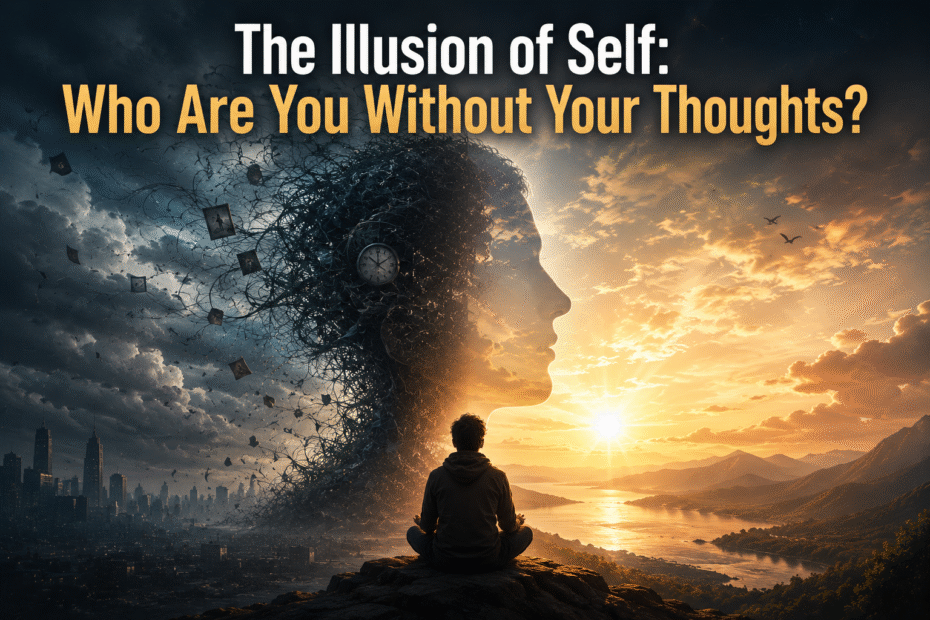
There is a strange question that most of us avoid – not because it is difficult, but because it is unsettling. It lingers in quiet moments, perhaps late at night or during a solitary walk, nudging at the edges of our awareness.
Who are you… without your thoughts?
At first, it sounds abstract. Almost philosophical. Maybe even unnecessary. After all, in our fast-paced, thought-driven world, we rarely pause long enough to consider such things. Your thoughts feel like you. They are the constant companions shaping your opinions, replaying your memories, and fueling that inner voice – the one that narrates your every experience from morning until night. This voice comments on everything: the decisions you make, the people you meet, the goals you chase. It feels deeply personal, intimate, and undeniably real. It defines your sense of identity, or so it seems.
But what if that voice is not you? What if it is just something… happening inside you? What if peeling back the layers of mental chatter reveals something far more profound and steady beneath it all? This question invites us on a journey inward, one that challenges our most basic assumptions about who we are. It is not about rejecting the mind but understanding its true role. By exploring this, we open the door to greater peace, clarity, and freedom – qualities that often feel elusive amid the noise of daily life.
The Voice in Your Head Is Not Always You
From the moment you wake up, your mind starts talking. Sometimes it begins gently, with plans for the day ahead: “What should I do today?” Other times, it dives straight into judgment or complaint: “I am tired.” “I am not good enough.” “I need to succeed at this or I’ll fail.” This internal monologue feels so personal, so intertwined with our sense of self, that questioning it can seem almost absurd. We trust it implicitly because it has been with us for as long as we can remember.
Yet, if you pause and observe closely, something fascinating emerges. You can hear your thoughts. They arise, unfold, and echo within your awareness. And if you can hear them, then who is the one listening? This simple shift in perspective changes everything. It reveals that there are two distinct layers operating within you at all times.
There is the thinker – the part of the mind that generates thoughts automatically, often without invitation. This thinker is shaped by a lifetime of experiences, cultural conditioning, fears, desires, successes, failures, and societal expectations. It draws from the past to predict the future, spinning scenarios that may never happen. It labels situations as good or bad, safe or threatening. It is busy, reactive, and deeply habitual.
Then there is the observer – the silent, steady presence that notices these thoughts without getting swept away by them. The observer does not argue, judge, or engage; it simply witnesses. It remains untouched by the content of the thoughts, whether they are anxious, joyful, critical, or creative. This observer is not loud or dramatic. It is calm, spacious, and ever-present. And paradoxically, it is closer to the essence of who you really are than any fleeting mental activity could ever be.
This distinction is not new; it echoes through ancient wisdom traditions and modern psychology alike. But in our everyday lives, we rarely notice it because we are so identified with the thinker. We mistake the stream of thoughts for the riverbed itself. Recognizing the observer allows us to step back, creating room for genuine self-understanding.
Your Identity Is a Story You Keep Repeating
Think about how you define yourself on a typical day. “I am an engineer.” “I am an introvert.” “I am someone who struggles with relationships.” “I am someone who overthinks everything.” These statements feel like solid facts, core truths about your character. They influence how you show up in the world, the opportunities you pursue, and the limitations you accept. But in reality, they are stories – narratives constructed over time and reinforced through constant repetition.
Your mind is a masterful storyteller. It collects fragments of experiences from childhood onward: a critical comment from a teacher, a moment of praise from a parent, a failure at work, a successful project. It labels these events, weaves them into a coherent plot, and then replays the narrative on loop. Over years, this story solidifies into what we call “identity.” We begin to live as if these labels define our unchanging essence.
Consider how often we reinforce these stories. An introvert might decline social invitations because “that’s just who I am,” missing out on potential connections. Someone who sees themselves as a perpetual struggler might interpret every challenge as confirmation of their inadequacy, rather than a temporary situation. The mind clings to these identities because they provide a sense of continuity and predictability in an uncertain world.
But here’s the liberating truth we rarely question: Just because a thought repeats, does not make it true. Repetition creates familiarity, not reality. You are not your past mistakes or triumphs. You are not your professional title, your personality quirks, or your emotional patterns. These are all transient phenomena appearing within your awareness. You are the awareness in which all of this appears – the open space that holds the stories without being defined by any single chapter.
Letting go of these rigid self-stories does not mean losing your sense of self. On the contrary, it frees you to respond to life more authentically, moment by moment, rather than through the filter of outdated scripts.
The Mind Is a Tool, Not Your Master
Your mind is an incredible instrument. It solves complex problems, generates creative ideas, plans for the future, and helps you navigate the practical demands of life. Without it, we could not build civilizations, compose symphonies, or innovate technologies. Its power is undeniable and worth celebrating.
Yet, like any powerful tool, it can become problematic when we forget its proper place. When the mind runs unchecked, it generates endless noise: comparisons to others, unnecessary fears about what might go wrong, imaginary scenarios of disaster or rejection, and self-doubt cleverly disguised as rational analysis. We scroll through social media and suddenly feel inadequate because the mind compares our behind-the-scenes reality to someone else’s highlight reel. We lie awake at night rehearsing conversations that may never occur.
Most of the time, we don’t even realize we are trapped inside this mental noise. We believe every thought as gospel truth. We react impulsively to every emotion it stirs up. We follow every mental impulse as if it were an absolute command. This identification turns the mind from servant into master, dictating our moods, decisions, and overall well-being.
But what if we began treating thoughts not as ironclad instructions but as mere suggestions? Suggestions from a well-meaning but often misguided advisor. When you create this distance, something profound shifts. You gain mental space – the breathing room to choose which thoughts to engage with and which to let pass. You cultivate clarity, seeing situations more objectively. You reclaim a sense of control, no longer at the mercy of every passing mental storm.
This does not diminish the mind’s usefulness. It enhances it. A tool used wisely is far more effective than one that controls its user.
The Gap Between You and Your Thoughts
Try this simple experiment right now, if you can. Sit quietly for a few minutes – perhaps close your eyes or soften your gaze – and simply watch your thoughts as they arise. Do not try to control them, suppress them, or judge them. Just observe with gentle curiosity.
What do you notice? Thoughts emerge on their own, often unbidden. One might be a worry about tomorrow’s meeting. Another could be a random memory from years ago. They linger for a while, pulling your attention, and then, without effort, they dissolve. New thoughts quickly replace them, creating a continuous stream.
Now, ask yourself this pivotal question: If thoughts come and go so freely… how can they possibly be you? You remain here, steady and aware, even as individual thoughts vanish into thin air. Your core existence does not flicker out when a thought ends. This reveals a fundamental gap – a space of awareness between you, the observer, and the thoughts themselves.
In that gap lies incredible freedom. It is the pause where you can choose your response instead of reacting automatically. It is the stillness beneath the turbulence. Many people spend their entire lives unaware of this gap, perpetually fused with their mental activity. Discovering it is like stepping out of a noisy room into fresh air. You realize you are not the weather of the mind but the sky that holds it all.
Why This Realization Changes Everything
Most of our suffering does not stem directly from external reality but from the stories we weave around it. A challenging situation arises – an argument, a setback at work, a health concern. The mind immediately constructs a narrative: “This means I’m failing,” “I’ll never recover from this,” or “Why does this always happen to me?” We then suffer not just from the event itself, but from our identification with that painful story.
When you fully identify with your thoughts, you become vulnerable to every emotional wave. Anxiety, anger, regret, and self-criticism pull you under like strong currents. But when you learn to observe thoughts without merging with them, you stay grounded. You acknowledge the emotion or thought – “Ah, there’s fear arising” – without becoming the fear. This does not mean you stop thinking or feeling entirely. Thoughts and emotions are natural parts of human experience. The transformation lies in no longer being controlled by them.
This shift brings profound benefits: reduced reactivity in relationships, greater resilience during difficulties, enhanced creativity because the mind is no longer cluttered with unnecessary noise, and a deeper sense of inner peace that persists even amid external chaos. Life’s challenges remain, but your relationship to them transforms.
So… Who Are You Without Your Thoughts?
You are not the voice in your head. You are not the endless noise of opinions, judgments, and narratives. You are not the constant narration that comments on every experience. Strip away the thoughts, even momentarily, and what remains?
You are the one who is aware of it all. Silent. Present. Unchanging. You are pure awareness – the witnessing presence that has been there since the beginning of your conscious life. It is the same awareness that observed your first steps as a child, your teenage heartbreaks, your adult achievements, and everything in between. It does not age, succeed, or fail. It simply is.
The more you connect with this deeper self through practices like meditation, mindful observation, or simply pausing during the day, the less lost and fragmented you feel. Life is no longer something happening to you, a series of events assaulting your fragile identity. Instead, it becomes something unfolding through you – an expression of the aware presence you fundamentally are.
Final Reflection
Maybe the goal is not to silence the mind completely, which can feel like an exhausting and often futile battle. After all, the mind is designed to think, just as the heart is designed to beat. Forcing total silence may miss the point.
Instead, the invitation is simpler and more compassionate: To stop mistaking the mind for who you are. Once this distinction becomes clear – not just intellectually but through direct experience – you no longer need to fight your thoughts. You can let them arise and pass like clouds in the sky. You stop believing everything they say, especially the harsh or limiting ones.
And in that moment of recognition, something beautiful and liberating happens. You do not lose yourself in some void of emptiness. You finally meet yourself – the real you that has always been here, waiting patiently behind the illusion.
This realization does not require retreating from the world. You can still think, create, love, work, and engage fully in life. But you do so with greater freedom, authenticity, and joy. The illusion of self begins to dissolve, revealing the vast, peaceful awareness that you have always been.
Embrace this inquiry gently. Return to it often. Each time you remember to observe rather than identify, you take another step toward the truest version of yourself. In a world full of distractions and demands, this inner homecoming is perhaps the most radical and rewarding journey of all.
-Sunil Kumar Gautam