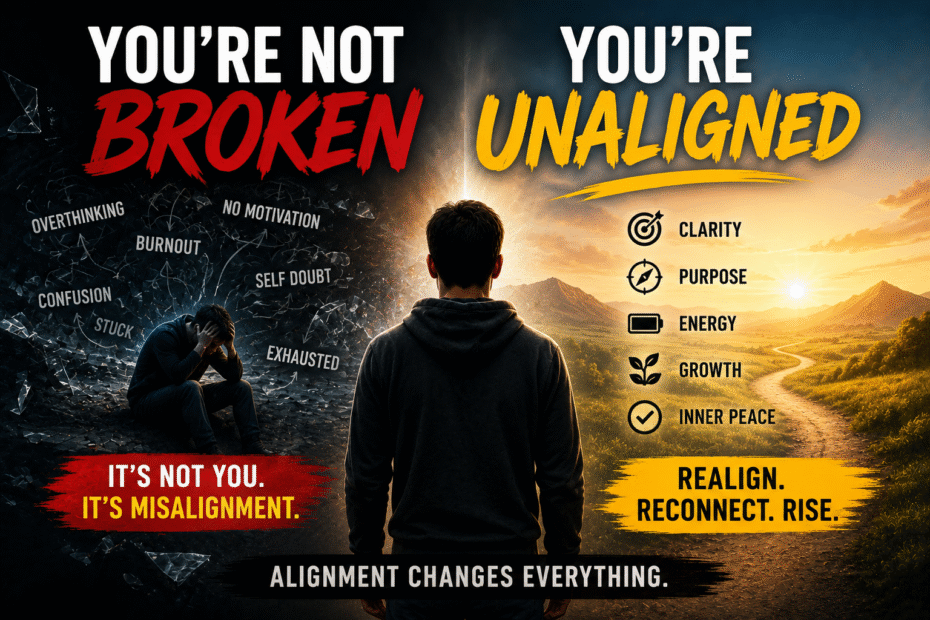
There are phases in life where nothing feels quite right. The days stretch on with a subtle heaviness. You wake up tired – even after what should have been a full night’s sleep. You try to focus on tasks, but your mind wanders or resists. You start new projects or routines, yet you don’t feel genuinely connected to them. Everything requires more effort than it should. And slowly, a dangerous thought begins to form in the quiet corners of your mind: “Maybe something is wrong with me.”
You start questioning your discipline, your intelligence, your consistency. You scroll through social media or observe friends and colleagues moving forward with apparent ease, and you wonder: “Why can’t I do what they’re doing?” This self-doubt can feel isolating and overwhelming. It chips away at your confidence and leaves you stuck in a loop of frustration.
But here’s a truth most people never hear: You are not broken. You are unaligned. And understanding this one idea can fundamentally change how you see your entire life. It shifts the narrative from self-criticism to compassionate awareness, opening the door to real transformation without the weight of shame.
The Difference Between Being Broken and Being Unaligned
When something is broken, it cannot function properly – even when placed in the right environment or given the right conditions. A shattered cup won’t hold water no matter how carefully you treat it. But when something is unaligned, it struggles not because it’s defective, but because it’s in the wrong environment, pointing in the wrong direction, or operating within a mismatched system.
Think of a plant. If it doesn’t grow in complete darkness, is the plant broken? Of course not. It simply needs sunlight, proper soil, and the right amount of water to thrive. You are no different. Your mind, your energy levels, your motivation – these are not random or faulty. They respond powerfully to alignment. When the conditions match your inner nature, growth happens more naturally. When they don’t, resistance and exhaustion follow. This distinction is liberating because it means nothing is inherently wrong with you. You just need to adjust the conditions.
What Does “Alignment” Actually Mean?
Alignment is the state where different parts of your life work in harmony. It happens when:
- Your daily actions match your core values
- Your environment supports rather than hinders your growth
- Your work and pursuits connect with your inner energy and strengths
- Your lifestyle respects your natural rhythm – whether you’re a morning person, a night owl, or someone who needs flexibility
When these elements are aligned, effort feels meaningful instead of exhausting. Progress begins to feel natural, almost effortless in its flow. Discipline doesn’t require constant white-knuckling; it emerges more lightly because you’re moving with your own current rather than against it.
But when alignment is missing, everything feels forced. You push through days that drain you, chase goals that don’t resonate, and wonder why life feels like an uphill battle. Alignment isn’t about perfection or some mystical state. It’s a practical, ongoing tuning of your life to who you truly are.
Why You Feel Stuck (It’s Not What You Think)
Most people assume they’re stuck because of personal shortcomings: lack of discipline, poor time management, or plain laziness. Society reinforces this harsh view, pushing productivity hacks and motivational speeches. But deeper insights from psychology suggest something far more compassionate and accurate: Resistance often comes from misalignment, not weakness.
Let’s break it down clearly.
1. Value Misalignment: Living a Life That Isn’t Yours
You might be pursuing goals, careers, or lifestyles that were never truly yours to begin with. Perhaps you chose a stable job for security rather than passion. Maybe your daily routines are shaped more by societal expectations than by your own desires. Success might be defined by external metrics – money, status, approval – rather than what fulfills you personally.
This creates a profound internal conflict. Your logical mind says, “Keep doing this,” while your deeper self whispers, “This isn’t me.” The result? Procrastination, fluctuating motivation, and emotional exhaustion. It’s not laziness. It’s your inner wisdom signaling disconnection from what truly matters.
2. Cognitive Dissonance: When Your Mind Is Split
Psychology refers to this as cognitive dissonance – the mental tension that arises when your beliefs, values, and actions are out of sync. For instance, you might deeply value peace and calm, yet live in a constant state of stress and overstimulation. You crave simplicity but find yourself chasing complex ambitions and endless obligations. You seek meaningful work but spend hours on tasks that feel empty.
This split creates significant mental friction, showing up as confusion, anxiety, and a persistent lack of clarity. Over time, it quietly drains your mental and emotional energy, making even small tasks feel monumental.
3. Nervous System Overload
Your body is constantly scanning for safety and coherence. When your life feels misaligned – stressful work, heavy decisions, unrestful rest – your nervous system remains in a low-level stress response. It never fully relaxes. This sustained activation leads to very real symptoms: brain fog, chronic fatigue, emotional ups and downs, and difficulty focusing.
In these moments, the common advice to “push harder” only worsens the problem. What you actually need is realignment, not more pressure. Your nervous system is asking for harmony, not force.
4. The Energy Leak You Don’t See
Unalignment causes energy to leak in subtle, invisible ways. You overthink minor decisions. You force yourself through tasks that don’t resonate. There’s constant low-grade internal resistance. It’s like driving a car with the handbrake partially engaged – you’re still moving forward, but it takes far more fuel and feels exhausting. These leaks accumulate, leaving you depleted even when your schedule isn’t objectively overwhelming.
5. The Identity Mismatch
At the deepest level, you may be trying to operate as someone you’re not. Perhaps you’re forcing hyper-productivity when your natural style is more reflective and thoughtful. You follow rigid systems when you thrive with flow and flexibility. Or you imitate others’ paths instead of discovering your own.
This identity tension creates resistance because humans are wired to seek authenticity. Living out of alignment with your true nature feels inauthentic, and your mind and body push back to protect you.
Why Modern Life Increases Misalignment
Today’s world is not built for alignment. It prioritizes speed over depth, comparison over self-clarity, and consumption over genuine connection. You’re bombarded daily with other people’s goals, highlight-reel lifestyles, and curated successes. Social media, advertising, and cultural pressures subtly shape your aspirations, often leading you to build a life that looks impressive on the outside but feels hollow within.
This constant external noise makes it easy to lose touch with your own inner compass. The result is widespread misalignment – and the epidemic of feeling “off” that so many experience.
Signs You Are Unaligned (Not Broken)
Read these carefully and without judgment. You are likely unaligned if:
- You feel drained even after completing “productive” work
- You procrastinate on things you logically think you “should” care about
- You feel lost despite having plans or direction
- You start many things but lack a real sense of connection to them
- You move through days feeling like you’re on autopilot, disconnected from joy or purpose
These are not signs of failure or defectiveness. They are important signals – gentle invitations to pause and realign.
So How Do You Realign Your Life?
Realignment doesn’t come from forcing yourself harder or copying someone else’s formula. It comes from reconnecting with yourself through curiosity and compassion. Here’s how to begin:
1. Stop Forcing, Start Listening
Instead of asking, “How can I be more disciplined?” try asking, “Why does this feel so heavy?” Treat resistance as valuable feedback, not an enemy to conquer. Listening reveals the root causes and guides you toward better-fitting paths.
2. Identify What Actually Matters to You
Strip away the external noise. Reflect deeply: What activities genuinely give you energy? What drains you quickly? What feels meaningful, even when challenging? This self-inquiry is the foundation of clarity.
3. Align Your Actions with Your Values
If freedom is a core value, avoid trapping yourself in overly rigid schedules. If creativity matters, don’t force purely mechanical routines. If growth calls to you, gently step out of long-term comfort zones. Even small shifts in this direction create powerful internal changes.
4. Redesign Your Environment
Your surroundings shape your behavior more than you realize. Reduce unnecessary distractions, create calm and inspiring spaces, and build simple systems that honor your natural flow. Alignment is both an inner and outer practice.
5. Move From Pressure to Purpose
Pressure tells you, “I have to do this.” Purpose whispers, “I choose to do this because it matters to me.” This subtle shift in language and mindset can transform your entire experience.
6. Accept That Alignment Takes Time
You won’t solve everything in a single day or week. Alignment is an ongoing process of experimentation, adjustment, and learning. Be patient with yourself. Each small insight lightens the load.
A Powerful Reframe
What if your inconsistency or struggles aren’t flaws at all? What if they are simply signals that you’ve been trying to live a life that doesn’t fully fit who you are? This reframe removes shame and replaces it with curiosity and possibility.
The Truth You Need to Hear
You don’t need to fix or overhaul yourself. You need to understand yourself more deeply. Once alignment begins to take root:
- Discipline starts to feel more natural
- Focus becomes easier and more sustainable
- Energy stabilizes rather than swinging wildly
- Progress flows in a more authentic, lasting way
Final Thought
You were never meant to force your way through life, battling against yourself at every turn. You were meant to flow with it – intelligently, consciously, and authentically.
So the next time you feel stuck or “off,” don’t default to harsh self-judgment. Pause and say instead: “Something in my life is out of alignment – and I am ready to find it.”
This gentle awareness is often the beginning of everything changing for the better. You’re not broken. You’re simply finding your way back to yourself.
-Sunil Kumar Gautam