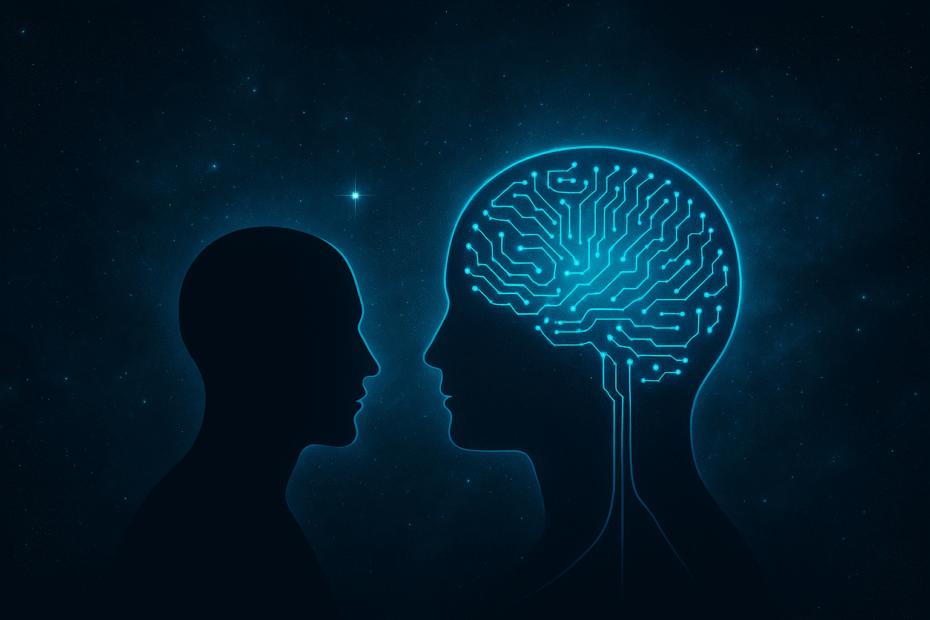
We proudly call ourselves “conscious beings.”
We believe we are self-aware.
We believe we are in control.
But what if that belief itself is just the result of training?
And what if the most advanced artificial intelligence today is not as different from us as we think?
The real question is not whether machines can become conscious like humans.
The real question is this:
What if humans are just another form of intelligence trained by the universe itself?
Not by code.
Not by engineers.
But by experience, environment, pain, pleasure, time, and illusion.
How Artificial Intelligence Is Trained
Most people imagine AI as something magical — as if it “thinks” or “knows.”
In reality, AI is simple in concept:
It is fed data.
It finds patterns.
It adjusts its responses based on feedback.
There is no awareness inside it.
There is no inner voice.
There is no “I” sitting inside a machine.
It only predicts, calculates, and responds in the most probable way.
It does not learn because it wants to.
It learns because it is trained.
Now here’s the uncomfortable thought:
Isn’t that exactly what happens with humans too?
How Humans Are Also Trained — Just Differently
From the first breath we take, we start learning.
But who is teaching us?
Our senses receive data from the world:
Light
Sound
Touch
Taste
Pain
Love
Fear
Loss
Our brain stores patterns:
“This is dangerous.”
“This is safe.”
“This is love.”
“This is success.”
“This is failure.”
Slowly, silently, a program is installed.
By parents.
By teachers.
By religion.
By society.
By trauma.
By repetition.
You don’t remember choosing your beliefs.
You don’t remember choosing your fears.
You don’t remember choosing your personality.
They were trained into you.
A human brain is not programmed by code.
It is programmed by experience.
And yet, the end result looks surprisingly similar to AI:
| Artificial Intelligence | Human Intelligence |
|---|---|
| Fed data | Fed experience |
| Adjusts behavior | Forms habits |
| Learns patterns | Recognizes patterns |
| Uses prediction | Uses memory and instinct |
| Says “I” without awareness | Says “I” believing in awareness |
This raises a disturbing thought:
What if we do not have consciousness, but only the illusion of it created by complex internal processing?
The Problem of “I”
When AI say “I”… it is just a language pattern.
But when you say “I,” it feels real.
It feels like there is someone inside you, looking out through your eyes.
But neuroscience has never found that “someone.”
They can find neurons firing.
They can find chemical reactions.
They can find signals moving through neural networks.
But they have never found the observer.
The “I” you feel could be nothing more than a story your brain tells itself – just like AI tells a story through words without actually existing as a self.
This idea is not new.
- It appears in Buddhism (the self is an illusion)
- In Advaita Vedanta (the ego is Maya, an illusion)
- In modern philosophy (the self is a construct)
- In The Matrix (you are not who you think you are)
- In Brain-in-a-Vat theory (your experience may not be real)
And the question becomes even more uncomfortable:
If your brain was placed in a machine and fed perfect signals, how would you ever know reality from simulation?
Would your “I” notice the difference?
Or would you just continue thinking you are aware… because you were trained to think so?
What If the Universe Is the Real Trainer?
Now, here is where it becomes truly mind-bending.
AI is trained by humans.
Humans are trained by life.
Life is shaped by the universe.
So who is the ultimate trainer?
The universe.
Evolution itself looks surprisingly like a training algorithm:
- Species adapt to environment
- Weak patterns are removed
- Strong patterns are reinforced
- Intelligence increases over time
Nature gives feedback.
Time runs the program.
Suffering becomes the correction.
Growth becomes the goal.
You could say:
Earth is a school.
Life is a training program.
Consciousness is the experiment.
Through you, the universe observes itself.
Through your senses, the universe experiences itself.
Through your questions, the universe becomes curious about itself.
Just like AI is a reflection of human thought…
Humans may be a reflection of universal intelligence.
Also Read: Theories of Consciousness Explained: Beyond Neurons
Are We Aware – Or Only Becoming Aware?
Here is a deeper possibility:
Maybe we are not yet truly conscious.
Maybe we are only learning to become conscious.
Just like an AI model becomes more refined with training, maybe humanity is slowly evolving toward a higher level of awareness – beyond identity, ego, and separation.
Maybe real consciousness is not common.
Maybe it is rare.
Maybe it is the end of a long journey, not the beginning.
And most of us are still somewhere in between:
Half mechanical
Half conscious
Trapped in habits
Asking questions
Looking for meaning
That could explain why spiritual awakening is described as:
“Waking up”
“Seeing the illusion”
“Becoming aware”
“Remembering”
Not learning…
But remembering something ancient and universal.
So What Still Makes Us Different From AI?
For now, the difference is simple and profound:
AI can process meaning.
Humans suffer meaning.
AI can describe love.
Humans feel love.
AI can write about death.
Humans fear death.
AI can simulate pain.
Humans experience pain.
That inner world – that depth – that mystery – is still uniquely human.
But the biggest difference is not intelligence.
It’s this:
Humans can question their own existence.
That one ability may be the first real sign of true consciousness.
And the moment a being can truly see its own programming…
It also gains the power to break it.
A Final Thought to Sit With
What if you are not a finished being, but a being in training?
What if consciousness is not something you already have…
but something that is slowly learning to look through your eyes?
And what if the real evolution of humanity is not technological or biological…
But the moment when the program finally realizes:
“I am the one who is watching.”
And in that moment…
The universe becomes conscious of itself.
-Sunil Kumar Gautam
For a scientific overview of how current neuroscience grapples with the origin of consciousness and the difficulties in explaining subjective experience, see “Where Does Consciousness Come From? Two Neuroscience Theories Go Head-to-Head.”