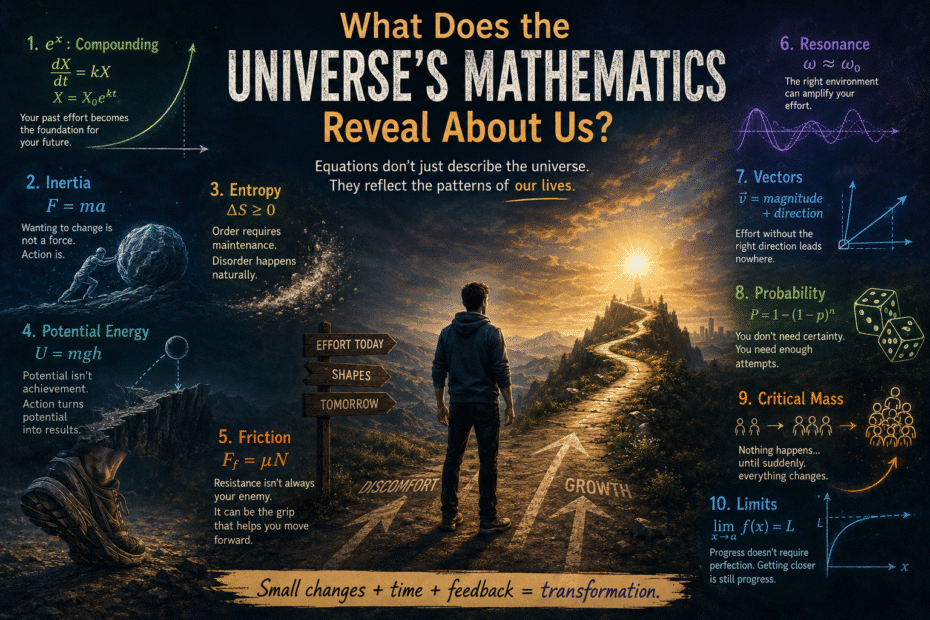
We usually think of mathematics as something that belongs in classrooms, laboratories, engineering drawings, and spreadsheets.
Equations calculate.
Physics describes motion.
Mathematics measures things.
But sometimes an equation does something more interesting.
It gives us a way to see ourselves.
What if exponential growth could teach us something about success?
What if entropy could explain why life becomes messy?
What if Newton’s laws could explain why changing your life is so difficult?
What if vectors could teach us why working hard isn’t enough?
These aren’t literal laws of human behavior. A human being isn’t a mathematical function.
But the patterns behind these equations often have surprisingly powerful parallels with human life.
Here are ten of them.
1. ex: Your Growth Can Start Compounding
One of the most beautiful equations in mathematics is:

It says something simple:
The rate of growth is proportional to what already exists.
The solution is exponential:
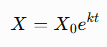
This is why exponential growth appears in things like idealized population growth, compound interest, and many natural processes.
But there’s a human version of this idea.
Imagine learning a new skill.
At first, you know almost nothing.
You spend hours learning the basics.
Then those basics make it easier to understand the next concept.
That knowledge makes the next concept easier.
Soon, you’re not just accumulating knowledge.
Your existing knowledge is helping you acquire new knowledge faster.
The same thing can happen with money, career experience, relationships, reputation, and an audience.
A skill can create an opportunity.
The opportunity creates experience.
Experience creates a better skill.
The better skill creates a bigger opportunity.
It becomes a loop:
Skill → Opportunity → Experience → Better Skill → Bigger Opportunity
This isn’t necessarily a perfect exponential curve.
Real life is far too messy for that.
But the principle of compounding is real.
And it gives us a powerful question:
Is today’s effort making tomorrow’s effort more powerful?
Because if it is, you’re no longer simply working.
You’re building a system that can grow.
2. Inertia: Wanting to Change Isn’t the Same as Changing
Newton’s first law tells us that an object tends to remain in its current state unless acted upon by an external force.
We call this inertia.
A stationary object wants to remain stationary.
A moving object wants to keep moving.
Human behavior has something that looks remarkably similar.
You can spend months thinking:
“I need to exercise.”
“I need to start that business.”
“I need to learn this skill.”
“I need to create content.”
“I need to change my career.”
But thinking about movement doesn’t create movement.
You need a force.
Action is that force.
And there’s an interesting second part.
Starting is often harder than continuing.
The first workout is difficult.
The first video is difficult.
The first article is difficult.
The first customer is difficult.
But once something is moving, maintaining momentum often becomes easier.
That’s why one of the most useful questions you can ask yourself isn’t:
“Do I feel motivated?”
It’s:
“What is the smallest force I can apply today to get this thing moving?”
You don’t have to transform your life today.
You just have to overcome its inertia.
3. Entropy: Why Everything Eventually Gets Messy
One of the most famous ideas in thermodynamics is entropy.
In simplified terms, systems tend to move toward greater disorder unless energy is supplied to maintain order.
Look around your room.
You don’t need to schedule a meeting with chaos.
Leave your room alone for a month and it will probably become messier.
Your files become disorganized.
Your inbox fills up.
Machines need maintenance.
Gardens need tending.
Relationships need attention.
Your body needs care.
There is a profound human lesson hidden here:
Order requires maintenance.
Chaos doesn’t need your permission.
It happens naturally.
That’s why maintaining your health, relationships, finances, career, and environment requires continuous effort.
And perhaps this explains something we often misunderstand about life.
We think:
“If I fixed this once, why did it become a problem again?”
Because maintenance isn’t failure.
Maintenance is part of the process.
You don’t “finish” taking care of your life.
You maintain it.
4. Potential Energy: Potential Isn’t Achievement
A stone sitting on a hill possesses gravitational potential energy:
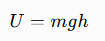
It has the potential to do work.
But potential energy isn’t the same thing as work being done.
This is a beautiful metaphor for human potential.
You can have:
- enormous intelligence
- great ideas
- natural talent
- knowledge
- creativity
- ambition
And still accomplish very little.
Because potential isn’t output.
Knowledge sitting inside your head isn’t yet impact.
An unwritten book has potential.
An unbuilt business has potential.
An unused skill has potential.
An idea sitting in your notebook has potential.
But potential only becomes meaningful when it is released through action.
You don’t get rewarded for the energy you could have released.
You get rewarded for the work that actually happens.
5. Friction: Resistance Isn’t Always Your Enemy
Friction opposes motion.
At first, that sounds like something we should eliminate.
But try walking without friction.
You can’t.
Your feet would simply slide backward.
Friction is what gives you grip.
And life works in surprisingly similar ways.
Deadlines create pressure.
Competition forces improvement.
Difficult problems build capability.
Constraints force creativity.
Failure forces adaptation.
Not all resistance is bad.
Sometimes the thing you’re fighting against is actually providing the grip required to move forward.
So when life becomes difficult, instead of immediately asking:
“How do I get rid of this?”
Try asking:
“What is this resistance making possible?”
The obstacle may still be painful.
But it may also be training you.
6. Resonance: Maybe You Don’t Need More Motivation
A system can experience a dramatically larger response when it is driven near its natural frequency.
This phenomenon is called resonance.
The interesting human analogy is this:
Sometimes the problem isn’t the amount of effort.
It’s the match between the effort and the environment.
Imagine trying to build something while constantly surrounded by distractions.
Or trying to learn in an environment that constantly interrupts you.
Or working on something you don’t care about.
You can keep increasing your effort.
But perhaps you’re pushing at the wrong frequency.
Change the environment.
Change the people around you.
Change the timing.
Change the system.
And suddenly the same person can produce dramatically different results.
Sometimes you don’t need more motivation. You need the right environment.
7. Vectors: Effort Isn’t Enough — Direction Matters
A vector has two fundamental characteristics:
Magnitude and direction.
You can have a very large vector pointing in the wrong direction.
And that’s exactly what happens in life sometimes.
Two people can work equally hard.
One moves toward financial independence.
Another moves toward burnout.
One builds valuable skills.
Another becomes extremely efficient at something that no longer matters.
Both are working.
Both are moving.
But their directions are different.
That’s why: Effort ≠ Progress
Progress requires effort in the right direction.
Before asking:
“How hard should I work?”
perhaps ask:
“Where is all this effort taking me?”
A small force in the right direction can sometimes be more valuable than a huge force in the wrong one.
8. Probability: You Don’t Need Certainty – You Need Attempts
Suppose an experiment has a probability p of succeeding on each attempt.
The probability of getting at least one success after n attempts is:
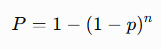
The important idea is simple:
More meaningful attempts change your odds.
This is incredibly relevant to life.
You apply for one job and get rejected.
Does that prove you’ll never get a job?
No.
You publish one book and it doesn’t sell.
Does that prove you’re a bad writer?
No.
You make one Reel and nobody watches it.
Does that prove you can’t create content?
No.
One attempt gives you one data point.
But repeated attempts give you information.
You discover what works.
You discover what doesn’t.
You improve.
And eventually, probability starts working in your favor.
You don’t need every attempt to succeed. You need enough attempts to give success a chance.
9. Critical Mass: Why Nothing Seems to Happen Until Suddenly It Does
Many systems behave differently after crossing a certain threshold.
A snowball gets bigger.
A network becomes useful when enough people join it.
A chain reaction can accelerate after enough conditions are met.
This idea of reaching a threshold is often called critical mass.
Human progress can feel similar.
You learn for months.
Nothing dramatic happens.
You post content.
Almost nobody watches.
You build a business.
Revenue barely moves.
You exercise.
The mirror doesn’t seem to change.
And then something happens.
A connection you’ve been building suddenly becomes useful.
Your accumulated skills suddenly combine.
Your audience starts sharing your work.
Your business finally reaches enough customers to become self-sustaining.
From the outside, it looks like:
“It happened overnight.”
But it didn’t.
The visible result appeared suddenly.
The invisible accumulation happened slowly.
That’s why the absence of visible results doesn’t necessarily mean the absence of progress.
Sometimes you’re not failing. You’re accumulating toward a threshold.
10. Limits: Progress Doesn’t Require Perfection
Calculus gives us the concept of a limit.
A function can approach a value increasingly closely:
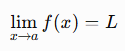
You can think of it as getting closer and closer.
And there’s a surprisingly useful lesson here.
We often think progress means:
“I need to become the final version of myself.”
But life doesn’t work that way.
You don’t need to become perfect.
You need to become closer.
One better decision.
One better habit.
One better conversation.
One more skill.
One more attempt.
One more day of consistency.
Progress isn’t always a dramatic jump.
Sometimes it’s simply:
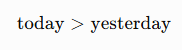
And repeated small improvements can eventually create a very large difference.
The Bigger Pattern
These equations aren’t motivational quotes disguised as science.
They describe actual mathematical or physical relationships.
But those relationships give us useful metaphors for understanding ourselves.
Exponential growth reminds us about compounding.
Inertia reminds us that action creates movement.
Entropy reminds us that everything requires maintenance.
Potential energy reminds us that potential isn’t achievement.
Friction reminds us that resistance can create traction.
Resonance reminds us that environment matters.
Vectors remind us that direction matters as much as effort.
Probability reminds us that attempts change our odds.
Critical mass reminds us that invisible accumulation can precede visible success.
Limits remind us that progress is about getting closer, not becoming perfect.
And perhaps that’s the most interesting thing about mathematics.
We usually think mathematics describes the world outside us.
But sometimes, if we look carefully enough, it also gives us a language for thinking about the world inside us.
The equations don’t tell us how to live.
But they can make us notice patterns we might otherwise miss.
And maybe the most useful equation isn’t even a mathematical one:

Because your life may not change dramatically tomorrow.
But if today’s actions change the person who makes tomorrow’s decisions, then tomorrow isn’t starting from the same place.
And that is where compounding begins.
-Sunil Kumar Gautam