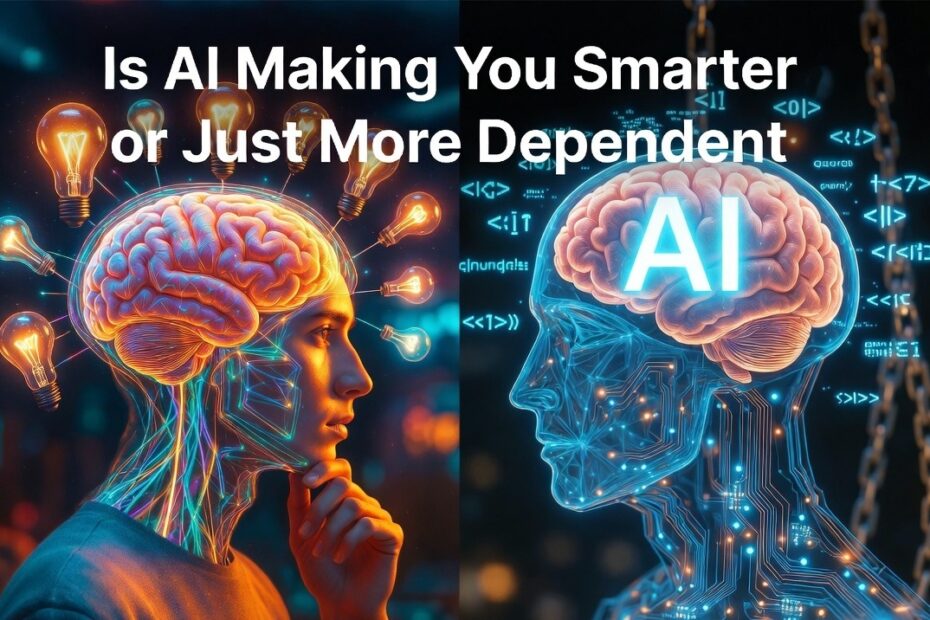
Artificial Intelligence has slipped into our daily lives so smoothly that we barely notice it anymore. One minute you’re stuck on a tricky problem at work or staring at a blank page, and the next, a quick prompt to an AI tool gives you a complete, polished answer. It feels magical. But here’s the question more and more people are quietly asking themselves: Is AI actually making us smarter, or are we just becoming more dependent on it?
This isn’t about robots taking over the world. It’s about something more personal – how AI is quietly reshaping the way we think, learn, solve problems, and even trust our own minds. In this article, we’ll explore the real impact of AI on our brains, the hidden risks of over-reliance, and how to use these powerful tools without losing your edge.
The Seductive Comfort of Instant Answers
Let’s be honest. There’s something incredibly satisfying about typing a question and getting back a clear, thoughtful response in seconds. No more late-night googling rabbit holes. No more wrestling with confusing concepts. AI feels like having a super-smart friend who’s always available.
You might walk away from that interaction feeling sharper and more capable. But pause for a second. Are you actually getting smarter… or are you just getting better at letting the machine do the heavy lifting?
This “instant intelligence” is addictive. And like many comforts in life, it comes with trade-offs we don’t always see right away.
Why Real Thinking Has Always Been Messy
Think back to a time when you truly learned something difficult. Maybe it was mastering a new skill, figuring out a complex project, or finally understanding a tough concept. It probably wasn’t easy. You felt confused, frustrated, and maybe even a little stuck.
That discomfort? That’s where real growth happens.
Our brains get stronger through effort – struggling with ideas, making mistakes, reflecting, and eventually connecting the dots ourselves. This process builds mental muscle, improves memory, and creates deeper understanding.
But when AI hands us neat, ready-made solutions, we often skip that uncomfortable but essential part. Over time, this shortcut can make our thinking feel a little softer around the edges.
How AI Can Quietly Weaken Critical Thinking
Critical thinking doesn’t develop by magic. It grows when we:
- Break down problems on our own
- Question assumptions
- Test different ideas
- Learn from failures
- Build connections between concepts
When we turn to AI first for every answer, we miss out on these mental workouts. The result? We might know what something means, but we don’t always understand why it matters or how it fits into the bigger picture.
This isn’t about AI being “bad.” The tool itself is neutral. The issue is how we use it. Constant dependence can lead to shallower thinking, less patience for hard problems, and a surprising drop in our ability to figure things out independently.
Many of us have felt it – that moment when you know AI could solve something faster, so you don’t even try to work through it yourself. Small habits like this add up. According to a 2025 study, frequent AI tool usage shows a significant negative correlation with critical thinking abilities, largely due to increased cognitive offloading.
What’s Actually Happening Inside Your Brain
Your brain is incredibly adaptable. It thrives on challenge and exploration. But when we offload too much thinking to AI, our habits shift.
Instead of deep focus and creative problem-solving, we start prioritizing speed and convenience. We consume more and create less. We become better at asking questions than at wrestling with them.
This doesn’t mean your intelligence suddenly drops. But you might notice:
- It gets harder to concentrate for long periods without digital help
- Ideas feel less original
- You second-guess your own thoughts more often
- Memory and recall feel a bit fuzzier on topics you usually let AI handle
The scary part? You often still feel smart because you’re surrounded by intelligent output. But having access to smart answers is very different from developing that intelligence yourself.
AI Intelligence vs. Human Intelligence: They’re Not the Same
AI is brilliant at processing huge amounts of information quickly, spotting patterns, and generating options. It’s fast, efficient, and never gets tired.
Human intelligence, on the other hand, brings something AI simply can’t replicate: real awareness, emotions, personal values, intuition, and the ability to care about the outcome. We make meaning. We connect with others. We create things that matter because we feel they matter.
The real risk isn’t that AI will become smarter than us. It’s that we slowly stop using the full power of our own minds.
We become skilled editors and prompters – which is useful – but we lose practice at being original thinkers.
The Quiet Risks We Don’t Talk About Enough
This goes beyond productivity. When every question has an instant answer, we lose tolerance for uncertainty. We become less comfortable sitting with confusion long enough for new insights to emerge.
Original thinking becomes rarer. Why struggle to form your own opinion when a well-crafted response is one click away?
Over time, this can chip away at self-trust. You might start doubting your unaided judgment. Students rush through assignments. Professionals lean on AI for strategic decisions. Everyone loses a little something in the process.
The good news? This isn’t inevitable. It depends entirely on how we choose to use these tools.
So… Is AI Actually Bad for Us?
Not at all.
AI is one of the most powerful technologies we’ve ever created. It helps doctors diagnose diseases faster, students learn more effectively, creators overcome blocks, and everyday people access knowledge that was once locked away.
The problem isn’t AI. It’s unconscious, habitual dependence.
The better question to ask yourself is: Am I still thinking for myself?
How to Use AI Wisely: A Practical Guide
Here’s the good news – you can enjoy all the benefits of AI while keeping your mind sharp. Try these simple habits:
- Think First Always start with your own ideas. Write a rough draft, brainstorm alone, or solve the problem manually before asking AI for help. Then compare and improve.
- Use AI as a Thought Partner Instead of asking for complete answers, ask it to challenge your thinking, point out weaknesses, or suggest different angles. Treat it like a smart colleague, not an oracle.
- Protect Your Deep Work Set aside regular time for “no-AI” thinking. Read physical books, journal by hand, solve puzzles, or discuss ideas with real people. Give your brain the workout it needs.
- Verify and Make It Yours Never copy blindly. Always check facts, add your own experiences, and rewrite in your own voice. This keeps you in the driver’s seat.
- Reflect After Using AI Ask yourself: What did I learn? How did this change my understanding? What would I have done differently without AI?
- Build Real Skills First Master the fundamentals in your field. Use AI to go further – not to skip the basics.
When you use AI this way, it becomes a genuine amplifier of your intelligence instead of a replacement.
Signs You Might Be Crossing the Line
Watch out for these subtle warning signs:
- You reach for AI even for simple decisions or ideas
- You struggle to explain things in your own words
- Your confidence drops when you can’t use AI
- You feel mentally lazy on topics you usually delegate
The moment thinking starts to feel optional instead of essential, dependence has taken root.
Final Thoughts: Staying Human in an AI World
AI isn’t going away. If anything, it will become even more powerful and integrated into our lives. The people who thrive won’t be those who use it the most – they’ll be the ones who use it most wisely.
Intelligence has always been about more than quick answers. It’s about curiosity, resilience, creativity, and the willingness to struggle a little for something meaningful.
Don’t let AI do all your thinking. Use it to stretch your mind, spark new ideas, and free up time for what truly matters. Stay curious. Keep questioning. And above all, keep thinking for yourself.
The future belongs to humans who know how to partner with AI – without handing over the steering wheel.
Frequently Asked Questions
Is AI making people less intelligent?
AI itself doesn’t lower your natural intelligence. However, relying on it too heavily can reduce opportunities to practice critical thinking, problem-solving, and deep focus. The key is balance.
Does using AI affect your brain?
Yes, in the sense that your brain adapts to how you use it. Regular mental challenges keep it strong, while constant offloading can make certain thinking skills feel rusty over time. The brain is like a muscle – use it or lose flexibility.
How can I use AI without becoming dependent?
Start with your own thinking first, use AI for feedback and refinement, verify everything, and regularly practice solving problems without it. Treat AI as a helpful assistant, not a replacement brain.
Can AI actually help improve thinking skills?
Absolutely – when used intentionally. Asking AI to critique your ideas, explain concepts differently, or explore alternatives can sharpen your mind and expose blind spots.
What’s the best way for students or professionals to use AI?
Use it to learn faster and create better, but always do the core thinking yourself. Document your process, add personal insights, and focus on building real understanding rather than just finishing tasks quicker.
-Sunil Kumar Gautam