
There is a particular kind of stuckness that doesn’t look dramatic.
You are not failing.
You are not depressed.
You are not even unhappy all the time.
Life looks fine from the outside – yet inside, there is a quiet fog.
You think a lot.
You scroll more than usual.
You postpone decisions, not because you don’t care, but because nothing feels clear enough.
If this feels familiar, let’s begin with a simple truth:
When life feels stuck, it’s rarely because you lack answers.
It’s because you’re asking the wrong question.
The Invisible Problem With Common Advice
When people feel stuck, they are usually told things like:
- “Follow your passion.”
- “Just take action.”
- “Think positive.”
- “Trust the process.”
None of this is wrong.
But none of it helps when clarity itself is missing.
Why?
Because advice assumes you already know what you want – and you don’t.
Telling someone to act without clarity is like telling someone to walk faster without telling them where to go. It increases movement, not direction.
What’s missing is not motivation.
What’s missing is the right starting point.
And that starting point is the question you are asking yourself.
The Question That Quietly Keeps You Stuck
Most people, when confused, ask some version of this:
It sounds reasonable.
It sounds responsible.
But this question is exactly why the mind freezes.
Here’s why this question backfires:
- It demands a perfect answer
- It invites fear of consequences
- It pulls in other people’s expectations
- It turns life into a multiple-choice exam with no correct option
The mind responds by overthinking, delaying, or escaping.
The problem is not your intelligence.
The problem is that this question is too shallow for a deep situation.
Before answers can appear, the question itself needs to mature.
How Clarity Actually Emerges (Not the Way We Expect)
Clarity does not arrive all at once.
It doesn’t begin as a confident decision or a bold plan.
It begins quietly – as emotional honesty.
Most people try to solve the outer problem first (career, relationship, purpose), while the real blockage exists at an inner layer.
Think of clarity like peeling an onion.
You don’t jump to the center.
You move through layers.
This is where a simple but powerful approach helps.
The 3-Layer Question Method
Every important life confusion has three layers of questions underneath it.
Most people stay stuck because they keep repeating only the first one.
Let’s go through them.
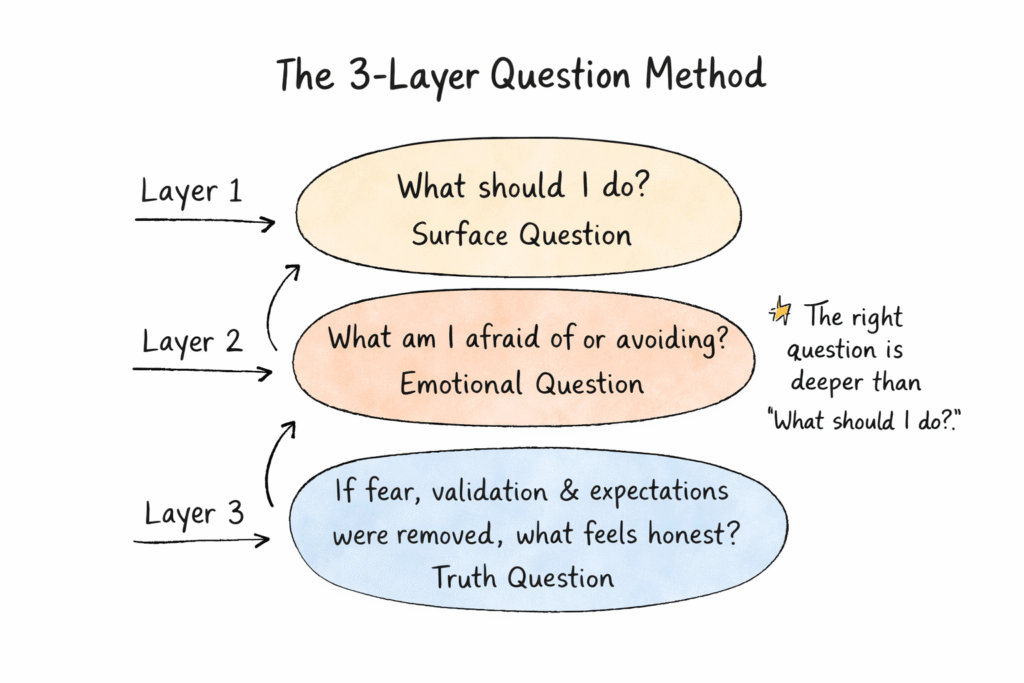
Layer 1: The Surface Question
This is the question you already know well.
- “What should I do with my career?”
- “Should I stay or leave this relationship?”
- “What is my purpose in life?”
These questions feel urgent, but they are vague.
They mix fear, logic, expectations, and uncertainty into one sentence – and the mind doesn’t know where to begin.
This layer is not wrong.
It’s just incomplete.
Layer 2: The Emotional Question
This is the question we often avoid.
- “What am I afraid of losing if I choose wrong?”
- “Who am I trying not to disappoint?”
- “What discomfort am I trying to escape?”
At this layer, clarity starts to breathe.
You may realize:
- You’re not confused about the job – you’re afraid of instability
- You’re not unsure about the relationship – you’re afraid of being alone
- You’re not lost in life – you’re afraid of wasting time
This layer does not give solutions.
It gives honesty.
And honesty reduces mental noise.
Layer 3: The Truth Question
This is the quietest and most uncomfortable layer.
It sounds like this:
“If fear, validation, and expectations were removed – what feels honest to me right now?”
Not what is impressive.
Not what is safe.
Not what others will approve.
Just what feels true.
The answer here is rarely dramatic.
Often, it’s simple. Subtle. Even inconvenient.
But it has a distinct quality – it feels lighter, even if it scares you.
That’s clarity.
What This Looks Like in Real Life
Case 1: Career Confusion
Surface question:
“Should I switch careers or stay where I am?”
Emotional question:
“I’m afraid of starting over and looking foolish.”
Truth question:
“I know I need growth more than comfort – even if I move slowly.”
Clarity doesn’t demand quitting tomorrow.
It demands honesty today.
Case 2: Relationship Uncertainty
Surface question:
“Is this relationship right for me?”
Emotional question:
“I’m afraid I won’t find better – or that I’m asking for too much.”
Truth question:
“I feel unseen, and I’ve been shrinking to maintain peace.”
Now the confusion makes sense.
Case 3: Spiritual or Existential Emptiness
Surface question:
“What is my purpose?”
Emotional question:
“I feel pressure to live a meaningful life.”
Truth question:
“Right now, I just want to feel present and alive again.”
Sometimes purpose is not a mission.
It’s a return.
A Simple 5-Minute Practice You Can Do Today
You don’t need journaling skills or deep analysis.
Just do this:
- Write your problem at the top of a page
- Write the surface question underneath
- Ask yourself the emotional question – answer honestly
- Then write the truth question and pause
Important rule:
Do not solve. Do not plan. Do not optimize.
Just notice what shifts.
Most people feel immediate mental relief – not because they found an answer, but because they stopped lying to themselves gently.
What to Expect After Asking the Right Question
Clarity doesn’t always feel good at first.
Sometimes it feels:
- Uncomfortable
- Inconvenient
- Quietly demanding
But something important changes:
- Mental noise reduces
- Energy stops leaking
- Small next steps become obvious
You may still move slowly – but you stop moving blindly.
You Were Never Lost – Just Misdirected
Feeling stuck is not a personal failure.
It’s a signal.
A signal that your life has grown more complex than the questions you’re asking.
When you ask shallow questions, life gives confusing answers.
When you ask honest questions, life responds with direction.
Not all at once.
But enough to take the next step.
And sometimes, that is all clarity is meant to be.
-Sunil Kumar Gautam