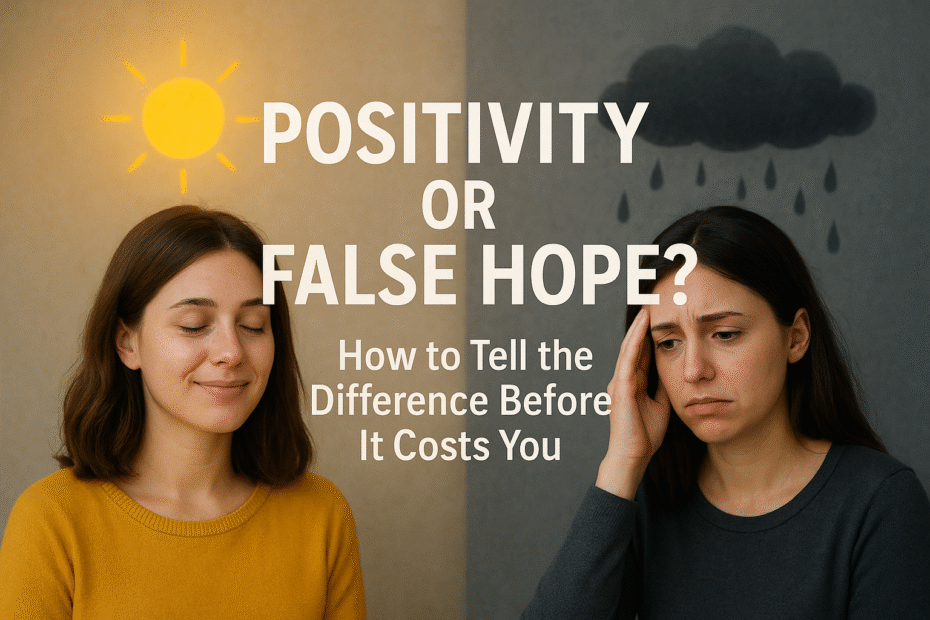
We live in a world obsessed with positivity.
“Think positive.”
“Don’t give up.”
“Everything happens for a reason.”
“Just believe and it will work out.”
These lines are repeated so often that questioning them almost feels like a sin. But here’s the uncomfortable truth no one likes to talk about:
Not all hope is healthy. And not all positivity is real.
Sometimes, what we call “positive thinking” is actually just fear wearing a happy mask. Sometimes, what feels like hope is really just denial in disguise. And when this goes unchecked, it can cost you years of your life, your mental peace, your self-worth, your health, and even your future.
So how do you know the difference?
When is positivity your strength… and when is it just false hope keeping you stuck?
Let’s explore that.
The Comfort Trap of False Positivity
False hope is seductive.
It wraps itself in comforting words and soft promises. It says:
- “Stay a little longer. Things will change.”
- “Don’t worry. Tomorrow will be better.”
- “It’s just a phase.”
- “If you believe hard enough, it will work.”
It allows you to stay in:
- A toxic relationship
- A draining job
- A declining business
- A harmful situation
- A damaging lifestyle
- An unhealthy body pattern
Not because it’s good for you… but because it feels safer than the unknown.
False hope feels warm for a moment.
But over time, it slowly suffocates your growth.
You don’t change.
You don’t move.
You wait.
Years pass. And one day you realize:
“I wasn’t being positive… I was just afraid.”
What Real Positivity Actually Looks Like
True positivity is not blind.
It is brave.
It is grounded in reality.
It does not ignore truth — it faces it head-on.
Real positivity sounds like:
- “This is painful, but I can handle it.”
- “This is not working, and I must choose better.”
- “I deserve more than this.”
- “I don’t know the outcome, but I trust myself.”
Real positivity = awareness + action.
It allows space for fear, sadness, confusion, grief, and still chooses movement.
It’s not about pretending everything is okay.
It’s about not losing hope in yourself even when everything is not okay.
That is strength.
False Hope vs Real Hope -The Psychological Difference
Here’s the simplest way to understand it:
True positivity faces reality. False hope hides from it.
| Real Positivity | False Hope |
|---|---|
| Accepts the situation | Denies the situation |
| Encourages action | Encourages waiting |
| Brings clarity | Creates confusion |
| Feels calm | Feels anxious inside |
| Leads to growth | Leads to stagnation |
| Empowers you | Weakens your intuition |
False hope keeps saying:
“Maybe if I stay silent… maybe if I don’t look too closely… maybe if I keep believing…”
Real hope says:
“It’s time to see clearly, even if it hurts.”
Signs You Might Be Living in False Hope
Ask yourself honestly:
- Are you repeating the same problem for years?
- Do you say “it will change” but never change your actions?
- Does thinking about the truth make you uncomfortable?
- Are you settling for less than you deserve?
- Are you afraid of being alone, judged, or starting again?
- Have your prayers become an excuse to avoid decisions?
- Do you feel stuck but keep calling it “patience”?
If the answer is yes to most of these — you may not be “positive”.
You may simply be trapped in comfortable suffering.
And recognition of that is the first step to freedom.
Why We Choose False Hope
False hope isn’t chosen because we are weak.
It’s chosen because:
- The unknown is terrifying
- Change feels risky
- Loss is painful
- Endings feel like failure
- Humans are emotional creatures
Hope gives safety. Even if it is fake.
But don’t confuse familiar pain with true safety.
Sometimes the most dangerous place is the one that feels most familiar.
Your mind prefers comfort.
Your soul prefers truth.
A Powerful Realisation to Remember
Let this sink in:
“Hope without action is an illusion.”
Repeating affirmations without changing your environment is not growth.
Praying without responsibility is not faith.
Waiting without courage is not patience.
And calling it “positivity” is self-deception.
How To Break Free From False Hope (Practical Steps)
This is the turning point. If someone reading this blog is in illusion – here is their path back to truth.
1. Face the situation as it is – not as you wish it to be
Write it honestly:
- What is happening right now?
- Has it improved or worsened in the last year?
- Is there respect, growth, progress, peace?
Truth is the doorway. Without it, there is no exit.
2. Accept the grief of what will never be
Sometimes you are not letting go of a person…
You are letting go of a dream that never came true.
And that hurts.
Let it.
Healing begins with grieving “what could have been”.
3. Ask yourself better questions
Instead of:
“What if it works out?”
Ask:
“What if I choose myself instead?”
“What if I stop waiting?”
“What if I start a new chapter?”
“What kind of life do I deserve?”
The quality of your life depends on the quality of your questions.
4. Take one small brave step
Not a big leap. Just one step:
- A boundary
- A conversation
- A resignation letter
- A therapist
- A journal
- A walk in a new direction
Small steps compound. That is real hope in action.
5. Redefine what positivity really means
Positivity is not believing everything will be fine.
It is believing:
“Even if everything is not fine, I am strong enough to rebuild.”
That is real power.
A Message to you
If you are reading this and feeling discomfort, don’t ignore it.
That discomfort is not negativity.
It is clarity trying to save you.
False hope whispers sweet lies.
Truth speaks once – but it sets you free forever.
Remember:
- Sometimes staying is NOT loyalty – it is fear
- Sometimes waiting is NOT patience – it is avoidance
- Sometimes hope is NOT spiritual – it is attachment
And sometimes the most positive thing you will ever do…
Is walk away.
FAQ:
How do I know if my positivity is real or just false hope?
Real positivity accepts reality and still chooses growth. It encourages action, problem-solving, and self-awareness. False hope ignores facts and depends only on wishful thinking. If your “positivity” makes you avoid difficult decisions or stay stuck, it is likely false hope, not true strength.
Why do people fall into false hope so easily?
False hope feels comforting and painless in the moment. The mind naturally avoids discomfort, so it prefers illusions over truth. People also get emotionally attached to outcomes and ignore warning signs. Over time, this attachment turns into denial, which feels like hope but quietly blocks growth.
Can staying positive ever delay important change?
Yes. When positivity is used to avoid facing problems, it becomes dangerous. Saying “everything will work out” without action can delay decisions, healing, and progress. Healthy positivity motivates change, but unhealthy positivity delays it. Awareness plus action is the key difference.
How can I shift from false hope to real positivity?
Start by accepting the truth of your situation without judgment. Then ask yourself what is in your control and what is not. Make one small, realistic move toward change. Real positivity is not about miracles – it is built through responsibility, clarity, and consistent effort.
Is it wrong to hope for the best while preparing for the worst?
No, this is actually the healthiest form of hope. It keeps your heart open to possibility while protecting you from disappointment. This balance creates strength, resilience, and maturity. It allows you to remain positive without losing touch with reality.
Final Words
False hope feels warm…
But real hope heals wounds, grows wings, and builds a future.
Don’t chase “everything will be OK”.
Chase:
- Alignment
- Truth
- Courage
- Self-respect
- Inner strength
That is the new definition of positivity.
And that is the hope that never lies.
-Sunil Kumar Gautam
Pingback: Sometimes, One Tiny Spark of Hope Is All You Need to Change Everything - iMySoul